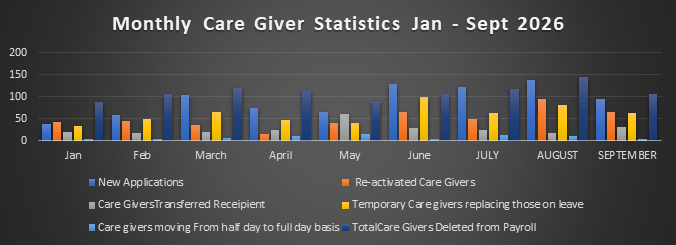
An analysis of caregiver registration and payroll data from January to September 2026 reveals a highly active workforce of care givers, the second quarter of the year marked by surging increase of care givers registered and quite a volume of deleted care givers from the SHCA payroll. While reasons for such are open to interpretation, the data highlights distinct operational cycles, showing that as demand scales up during mid year, system-wide adjustments in registrations quickly follow.
New applications peaked dramatically in August, hitting a yearly high of approximately 144 applications. Intake remained exceptionally robust across the second quarter of the year, June recording 128 applications and September sustaining momentum at 105 applications. In contrast, the year started at a much slower pace in January with only 38 new applications.
As permanent care givers took time off during the second quarter of this year, the registry relied heavily on replacement care givers to prevent service gaps. The demand for temporary caregivers replacing those on leave skyrocketed in June, reaching a peak of 100 temporary registrations. This temporary coverage remained heavily active through July (62), August (81), and September (63), proving that short-term placements are vital to meet demands.
The volume of caregivers deleted from the payroll remained high and volatile, peaking sharply in March (103 deletions) and July (117 deletions). These massive waves of departures closely parallel the peak hiring months.
Internal Movements and Hours Remain Steady
• Recipient Transfers: The number of caregivers transferring to a different recipient peaked in May at 61 transfers. For the remaining eight months, this metric stayed low and stable, generally hovering between 15 and 30 cases monthly.
• Shift to Full-Time: Caregivers moving from a half-day to a full-day basis barely fluctuated, consistently representing the lowest metric on the chart. It reached its small peak in May at just 16 caregivers, remaining under 12 cases for every other month of the period.